
Mobile patrol security and static security guards both play important roles in protecting businesses, properties, and assets. Mobile patrol security involves trained security officers conducting scheduled or random inspections of a site, while static security guards remain on-site to provide continuous monitoring and immediate response. The best option depends on your property’s size, risk level, operating hours, and security requirements. Many UK businesses achieve the strongest protection by combining both services into a comprehensive security strategy.
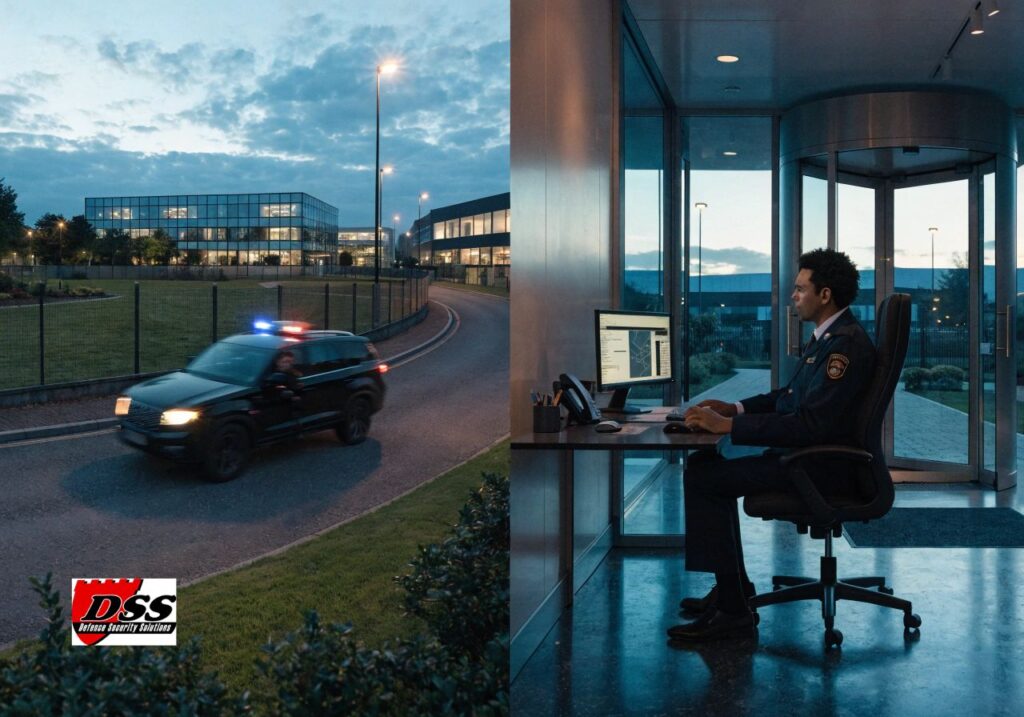
Mobile patrol security involves trained security officers conducting inspections of a property at predetermined times or on random schedules.
Unlike static guards who remain on-site, mobile patrol officers travel between locations and perform security checks throughout their shift.
Mobile patrol services typically include:
The visible presence of patrol vehicles and uniformed officers acts as a deterrent against criminal activity.
A professional security company develops a patrol schedule based on the client’s risk profile.
Security officers may:
Randomized patrol schedules are often used because they make it difficult for criminals to predict officer movements.
This unpredictability significantly improves site security.
Businesses across the United Kingdom face a growing range of security threats, including theft, vandalism, trespassing, anti-social behaviour, unauthorized access, and property damage. Whether operating a construction site, warehouse, retail store, corporate office, or residential development, protecting people and assets remains a critical business priority.
Security incidents can lead to:
As a result, many organizations invest in professional security services to safeguard their premises and maintain business continuity.
A static security guard remains physically present at a location throughout their shift.
Static security officers provide continuous monitoring and protection of a designated property, facility, or event.
Common responsibilities include:
Static guards provide a visible security presence that can discourage criminal activity and improve safety for employees, contractors, and visitors.
Despite advances in CCTV, artificial intelligence, and remote monitoring technology, human security officers remain a vital part of physical security.
Technology can identify unusual activity, but it cannot replace human judgement.
A trained security officer can assess situations, communicate with individuals, make decisions during emergencies, and take appropriate action.
This human element becomes especially important in situations involving:
The ability to respond immediately is one of the strongest advantages of static security guarding.
The biggest difference between the two services is the level of continuous presence.
Mobile patrol security provides flexible coverage through scheduled inspections, making it suitable for businesses that need deterrence and monitoring without full-time guarding.
Static security provides dedicated protection where an officer remains on-site and can respond instantly to incidents.
A simple comparison:
| Factor | Mobile Patrol Security | Static Security Guards |
|---|---|---|
| Security Presence | Periodic visits | Continuous presence |
| Response Time | Dependent on patrol schedule | Immediate |
| Cost Level | Generally lower | Generally higher |
| Access Control | Limited | Extensive |
| Best Application | Low-medium risk sites | High-risk environments |
However, cost alone should not determine the decision. The correct security solution depends on the consequences of a potential incident.
Construction sites are among the most common environments where businesses compare mobile patrols and static guards. These locations often contain expensive machinery, tools, fuel, and materials that attract criminals. For smaller construction projects with lower-value assets, mobile patrol security may provide an effective solution by monitoring the site outside working hours.
However, large-scale developments, infrastructure projects, and high-value construction sites often benefit from static security guards because they require continuous monitoring, access control, and immediate intervention.
Many construction companies now use a combination approach:
This layered approach provides stronger protection than relying on a single security measure.
The best security decisions are based on risk assessment rather than assumptions.
A professional security assessment considers:
For example, a small office building and a large industrial warehouse may require completely different security strategies even if they are located in the same area. A tailored assessment ensures businesses invest in security measures that provide genuine value.
The future of commercial security is not about choosing between human guards and technology. It is about combining both.
Modern security strategies increasingly integrate:
Artificial intelligence and smart surveillance systems can improve detection, but trained security professionals remain essential for decision-making and physical intervention.
The strongest security environments are created when technology supports people rather than attempting to replace them.
Defence Security Solution provides professional security services designed around the specific needs of UK businesses.
Rather than offering a one-size-fits-all approach, security strategies are developed based on each client’s operational requirements and risk profile.
Mobile patrol security is usually more cost-efficient because officers visit multiple locations instead of remaining permanently at one site. However, the correct choice depends on the level of protection required.
Neither service is universally better. Static guards are more suitable where immediate response and continuous monitoring are required, while mobile patrols work well for flexible protection.
For some low-risk properties, mobile patrols may provide sufficient protection. High-risk locations often require a combination of services.
CCTV supports security operations but cannot replace human intervention. The strongest protection usually combines surveillance technology with trained security professionals.
Choosing between mobile patrol security and static security guards depends on your business’s unique requirements, risk profile, and operational objectives.
Mobile patrols offer flexible and cost-effective protection for lower-risk environments, while static security guards provide continuous monitoring, access control, and immediate incident response for higher-risk sites.
For many organizations, the most effective strategy combines both services alongside CCTV monitoring, alarm response, and access control systems.
By investing in professional security services, businesses can reduce risk, protect valuable assets, and create safer environments for employees, contractors, and visitors.
Defence Security Solutions provides dependable security services tailored to the needs of businesses, organisations, and facilities throughout the UK. With a focus on professionalism, reliability, and service excellence, we deliver effective security solutions that safeguard people, property, and assets while supporting our clients’ operational objectives.